Digital Gaming Infrastructure: A Comprehensive Overview of hot77.com and the Online Casino Industry
TODAY
13.4MB
v1.1.1
Android+IOS
445+

Description
Introduction
The digital transformation of the gambling sector has shifted entertainment from physical brick-and-mortar establishments to internet-accessible software applications. Among the various portals servicing this digital space, web domains such as hot77.com represent the contemporary structure of the online gaming market. These platforms operate as digital interfaces hosting software-driven versions of traditional betting games, including digital reels, table simulations, and live-streamed table rooms.
Understanding the operational modalities of hot77.com requires an evaluation of the technical, legal, and consumer-safety frameworks that govern virtual wagering. This article provides a comprehensive, neutral overview of the structural mechanics of modern gaming platforms, their regulatory standards, security mechanisms, and the statistical realities governing user participation on sites like hot77.com.
The Evolution of Online Casino Platforms
The online casino sector originated in the mid-1990s following the passage of the Free Trade and Processing Act in Antigua and Barbuda in 1994. This legislation permitted the issuance of licenses to organizations seeking to establish gambling services over the internet. Concurrently, cryptographic software developed by early security firms provided the foundation for secure digital financial transactions, a prerequisite for virtual cash wagering.
The initial era of internet gambling relied heavily on downloadable client software, requiring users to install dedicated executables onto desktop computers. By the mid-2000s, the introduction of Adobe Flash enabled browser-based play, eliminating the installation barrier. In the contemporary landscape, platforms like hot77.com leverage Hypertext Markup Language 5 (HTML5), a cross-platform standard enabling uniform game execution across mobile operating systems (iOS, Android) and desktop browsers without third-party plugins. For players exploring the market, understanding the foundational infrastructure behind hot77.com highlights how the industry transitioned into modern, lightweight web applications.
Classification of Digital Casino Game Types
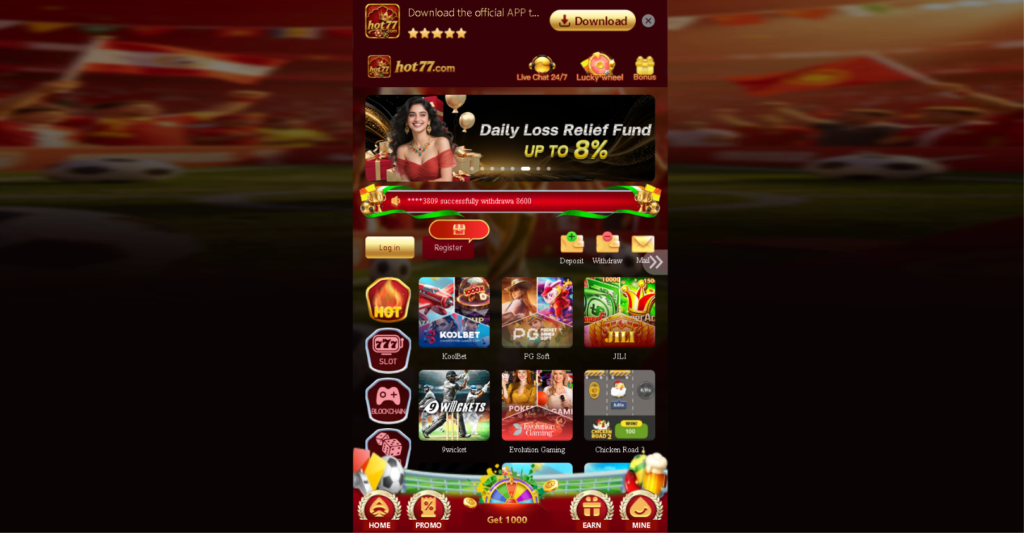
Platforms operating within the paradigm of hot77.com classify their software portfolios into distinct technical categories based on mechanics, payout structures, and interactive elements.
1. Video Slots and Classic Reels
Virtual slots form the quantitative majority of any gaming catalog found on modern domains, including hot77.com. Modern platforms utilize multi-reel architectures displaying variable payline systems, cluster-pays, or Megaways mechanics that alter the row configuration dynamically on each iteration. These games rely heavily on audio-visual theme integration but remain fundamentally driven by underlying mathematical constraints.
2. Table Games (Simulated)
This category encompasses digitized adaptations of traditional card and wheel games available across the web and on dedicated web hubs like hot77.com.
- Blackjack: Software simulations where players attempt to achieve a hand value closer to 21 than the virtual dealer without exceeding the limit.
- Roulette: Graphic interfaces depicting European, American, or French wheels, permitting bets on specific numeric distributions, colors, or odd/even variances.
- Baccarat: An automated comparison game between two hands—the “Player” and the “Banker.”
3. Live Dealer Modules
To bridge the gap between physical and digital spaces, platforms host live-streamed studios where human dealers manage physical cards or wheels in real-time. When interacting with online setups such as hot77.com, Optical Character Recognition (OCR) technology translates physical occurrences (such as a dealt card or a ball landing in a slot) into digital data, displaying outcomes instantly on the player’s user interface.
Legality, Licensing, and Jurisdictional Regulations
The legal status of a user accessing hot77.com depends entirely on the geographical location from which the connection originates. Global gaming regulation is decentralized and broadly falls into three jurisdictional models:
| Regulatory Model | Operational Framework | Representative Jurisdictions |
| Monopolistic/National Licensing | Explicit domestic licensing required; high taxation; strict consumer protections. | United Kingdom (UKGC), Malta (MGA), Germany (GGL) |
| State-by-State Frameworks | Sub-national entities dictate legality individual to localized state boundaries. | United States (e.g., New Jersey DGE, PGCB), Canada (i.e., iGaming Ontario) |
| Offshore/Unregulated Markets | Platforms host servers in international jurisdictions, catering to regions without explicit statutory prohibitions. | Curaçao eGaming, Anjouan, Costa Rica |
Compliance frameworks dictate that international operations operating similarly to hot77.com must utilize geolocation technology (such as IP lookups and GPS triangulation) to identify user positioning and restrict entry to individuals from prohibited regions.
Technical Security, Auditing, and Fairness Verification
To establish market credibility, digital operators like hot77.com utilize distinct technological protocols designed to ensure data integrity and game randomicity.
Random Number Generators (RNG)
Virtual games rely on a Pseudo-Random Number Generator (PRNG) algorithm to determine outcomes. These mathematical models start with a base value (the “seed”) and execute complex algorithmic formulas to yield sequence outputs that mimic complete randomness. Because outcomes are generated independently of prior results, consecutive spins or deals carry identical statistical weights on audited servers like hot77.com.
Cryptographic Protocols
User communication with hot77.com is protected by Transport Layer Security (TLS) or Secure Sockets Layer (SSL) encryption protocols. This encryption standard converts data packets—such as authentication credentials and financial payment indicators—into ciphertext, preventing interception by unauthorized network actors during transit.
Independent Testing Audits
Legitimate software configurations undergo recurrent evaluations by specialized third-party auditing firms, including:
- eCOGRA (eCommerce Online Gaming Regulation and Assurance)
- iTech Labs
- GLI (Gaming Laboratories International)
These agencies stress-test game source codes over millions of simulated iterations to verify that empirical payout metrics align accurately with the published Return to Player (RTP) percentages displayed across official hot77.com software channels.
User Experience, UI Design, and Technical Accessibility
The layout of a web application like hot77.com relies on precise User Interface (UI) and User Experience (UX) design models intended to optimize navigation.
- Asset Optimization: Game suites load micro-assets and compressed visual data via Content Delivery Networks (CDNs) to minimize latency on low-bandwidth connections.
- Responsive Layouts: Interfaces auto-adjust grid orientations to match the technical specifications of mobile phones, tablets, or widescreen monitors accessing hot77.com.
- Navigational Categorization: Search configurations utilize systemic filters, allowing sorting by software provider, volatility matrix, or mechanical structure.
Debunking Common Gambling Myths and Misconceptions
The mathematical reality of digital gambling is frequently obscured by psychological cognitive biases. Addressing these misconceptions is critical for maintaining an objective assessment of digital platform behavior on sites like hot77.com.
The Gambler’s Fallacy
The erroneous belief that past independent events influence future outcomes. For instance, if a roulette simulation lands on red five consecutive times, the fallacy suggests a black outcome is “due.” In reality, the PRNG resets the probability parameters cleanly with every single spin; the mathematical chance remains exactly unchanged whether playing on a local application or an online domain like hot77.com.
“Hot” and “Cold” Platforms
Players often characterize platforms or specific slots as being “hot” (yielding high payouts) or “cold” (withholding payouts). Because audited games function on static RTP formulas across their entire lifecycle, temporary fluctuations constitute standard statistical variance rather than intentional, algorithmic cycles designed by hot77.com or its providers.
Near-Miss Manipulation
A psychological phenomenon where visual elements halt just short of a winning combination (e.g., two identical symbols matching with a third symbol stopping one position off the payline). While physical mechanics in historic machines occasionally produced this visual effect, modern audited systems generate outcomes uniformly via numbers, rendering visual “near misses” merely as standard unaligned data configurations.
Potential Risks and Precautions for Players
Engaging with digital gaming portals carries verified structural risks, necessitating standard precautionary steps to protect personal data and capital when visiting URLs such as hot77.com.
Risks:
- Financial Depreciation: Due to built-in house edges, long-term continuous engagement with casino platforms statistically results in a net financial loss for the user.
- Data Vulnerability: Registering on unverified or unencrypted portals exposes users to credential harvesting and potential identity exploitation.
- Improper Terms of Service: Certain platforms embed complex wagering requirements within corporate policy, restricting the withdrawal of capital until specific turnover thresholds are met on the hot77.com network.
Precautions:
- Domain Validation: Verify HTTPS status and security certificates before transmitting profile information to hot77.com.
- Review Policy Documents: Read the specific Terms and Conditions regarding withdrawal caps and identification checks (Know Your Customer / KYC).
- Isolation of Capital: Avoid sharing banking credentials used for critical daily living expenses with entertainment platforms.
Responsible Gambling Frameworks and Harm Mitigation
The development of severe behavioral dependencies remains a documented risk within the online gaming sector. Responsible gambling programs aim to provide structural roadblocks within the platform architecture to mitigate harm.
Modern platforms implement user-facing safety configurations within their account dashboards, allowing players visiting hot77.com to establish structural limits:
- Deposit Thresholds: Restricting the gross volume of currency transferable into an account over daily, weekly, or monthly periods.
- Session Time Clocks: Enforcing automated logs to prevent continuous, unmonitored play cycles.
- Self-Exclusion Protocols: A binding security status that blocks account access and bars the creation of duplicate accounts for fixed windows (ranging from 6 months to permanent closure) on hot77.com.
Global Support Notice: Individuals experiencing gambling-related distress or compulsive behaviors can access free, confidential guidance through international organizations such as Gamblers Anonymous or localized entities like the National Council on Problem Gambling (NCPG).
Future Trends in Online Wagering Infrastructure
The technologies supporting systems like hot77.com undergo constant refinement. Several structural trends are currently redefining the online gambling sector:
Decentralized Blockchain Ledgers
The integration of blockchain technology allows for cryptocurrency payments (Bitcoin, Ethereum, USDT) alongside traditional fiat processing. Some decentralized applications utilize “Provably Fair” cryptographic algorithms, enabling users to manually verify the randomness of an outcome by comparing the pre-round server seed and client seed on a public ledger.
Virtual and Augmented Reality (VR/AR)
Headset integration allows for the creation of immersive 3D casino spaces, letting users navigate virtual rooms and interact visually with software elements in real-time, moving past traditional flat 2D screens.
Artificial Intelligence Behavioral Analytics
Operators increasingly deploy machine learning models to track real-time player data. These algorithms monitor account activity for rapid escalation in bet sizing or extended session durations, allowing the system to flag potential risk markers and auto-trigger responsible gaming interventions across modern digital systems like hot77.com.
Conclusion
Online casino portals like hot77.com represent the intersection of modern software engineering, advanced mathematical modeling, and international regulatory frameworks. While technological advancements have streamlined the user experience, improved data security, and standardized fairness auditing through independent testing, the foundational nature of casino gaming remains unaltered. Every game operates with a distinct mathematical advantage favoring the house, meaning long-term engagement statistically results in financial loss. Consequently, an objective understanding of platform mechanics, licensing parameters, and active risk mitigation strategies is essential for evaluating or navigating the digital gambling ecosystem safely.
you can also play this game for more earning money WWW.PK2026.BET